
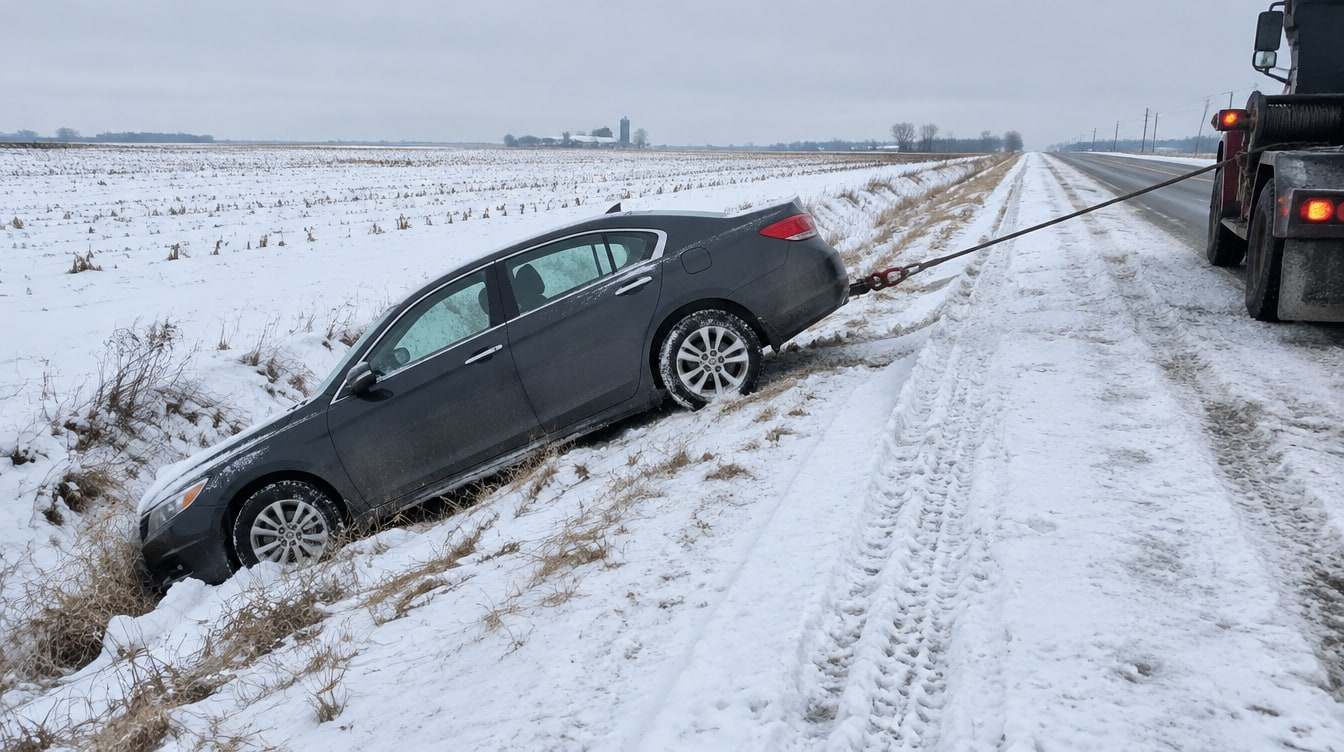
When a winch-out is the right call
A winch-out is for a car that is stuck but upright and mostly undamaged. Match what you see to what to ask for:
| Where the car is | What to ask for | Can it usually drive away after? |
|---|---|---|
| Slid into a shallow ditch off a snowy or icy road | Winch-out | Often, if nothing was hit |
| Wheels sunk in mud, a soft shoulder or a wet lawn | Winch-out | Often |
| Buried at the curb or in a driveway snowbank | Shovel first; then a winch-out if that fails | Usually |
| Hit a pole, sign, tree or another car on the way off the road | Accident recovery | Depends on the damage |
| On its side or roof, down a steep bank, or in water | Recovery with heavier equipment; call 911 if anyone is inside or hurt | Rarely |
Tell the dispatcher which of these fits. A car a few feet off the shoulder needs different equipment from one at the bottom of a deep ditch.
First: get safe and stop spinning the tires
If the car came to rest near a travel lane, stay inside with your seat belt on and the hazards flashing, and call 911 if anyone is hurt or the car blocks traffic. The National Weather Service’s advice for drivers stuck in a storm is the same: stay in the vehicle (NWS).
If a few gentle tries forward and back don’t free the car, stop. Spinning the tires tends to dig them in deeper and can polish the snow under them into ice. Sand or cat litter under the drive wheels can help, which is why both NHTSA and the NWS put it in their winter car kits. NHTSA also warns against overexerting yourself while digging (NHTSA).
Carbon monoxide: the danger in a snowbound car
A running engine with a blocked tailpipe can fill the car with carbon monoxide, which you can’t see or smell. If you need heat while you wait:
- Clear the snow away from the exhaust pipe before you start the engine, and check it again if snow keeps falling or drifting.
- Run the engine about 10 minutes each hour for heat, not nonstop (NWS).
- Open a window a little while it runs.
- At night, turn on the dome light while the engine runs so rescuers can see the car. Tie a bright cloth to the antenna or door, and raise the hood once the snow stops.
NHTSA says not to run the car for long with the windows up or in an enclosed space.
Call for towing help(419) 329-4502Where Toledo-area drivers slide off
- County roads. Blowing and drifting snow on rural roads in Lucas and Wood counties is a documented winter hazard, and it is one of the conditions that can push Lucas County to a higher snow emergency level. Drifts can fill a lane between plow passes, so a road that was fine on the way out of Perrysburg may not be on the way back.
- Near the lake. Toledo rarely gets heavy lake-effect snow, but northeast winds can occasionally add lake-enhanced snow near Lake Erie, on the Oregon side of the bay.
- City side streets. Toledo generally doesn’t plow or salt residential streets unless snowfall tops 3 inches, so cars get stuck at the curb and in alleys. If yours is stuck on a snow emergency route during a parking ban, police can ticket and tow it (City of Toledo).
When the Lucas County Sheriff declares a Level 3 snow emergency, roads are limited to emergency and essential personnel, and violators may be arrested (University of Toledo summary). That doesn’t apply to the Ohio Turnpike, where only Turnpike contract garages may tow a passenger car off (OAC 5537-3-01); dial #677 there. The stuck in snow guide covers more winter situations.
When a winch-out turns into a tow
Once the car is back on solid ground, look and listen before you drive off. Ask for a tow instead if:
- it hit something on the way in, or a wheel is bent or a tire has come off the rim;
- the steering wheel sits off-center or the car pulls hard to one side;
- fluid is dripping, or warning lights stay on after it starts;
- it won’t start, or it dies after a few seconds.
A damaged car usually goes on a flatbed. Ask for the combined price of the winch-out and the tow before work starts; recovery work may be billed separately from the tow. The tow cost guide explains how.
How a request works
- Make sure everyone is safe; call 911 first if anyone is hurt or a lane is blocked.
- Call (419) 329-4502 or send a request.
- Describe where you are: the road, the nearest crossroad or mile marker, and your direction. On a rural road, drop a map pin from your phone.
- Describe how you’re stuck: snow, mud or ditch, how far off the pavement, how deep, and whether the car hit anything.
- Ask for the price before work starts.
- While you wait, keep the exhaust clear and your phone charged. If the car can’t be made safe to drive, ask for an emergency tow instead.