
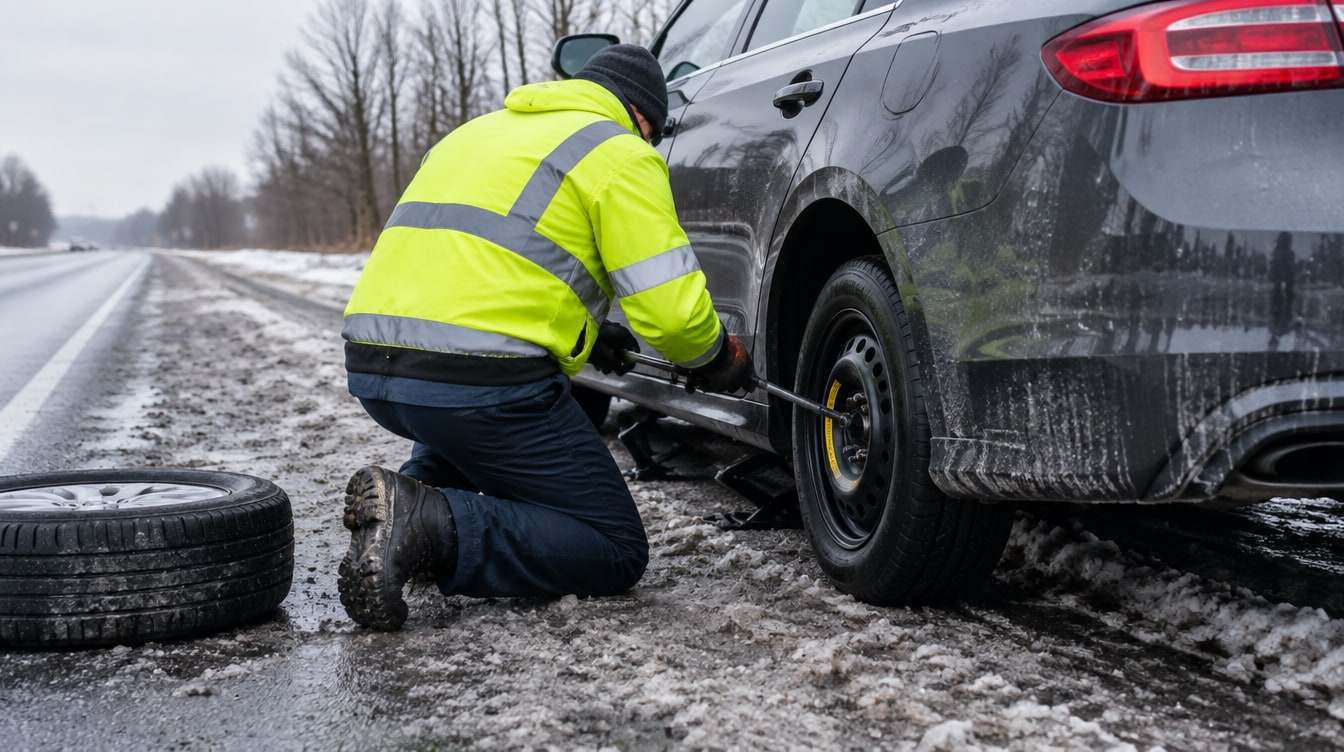
Get somewhere safe before you touch the tire
- Slow down gradually, signal, and pull as far from traffic as you can: the shoulder, a ramp, a side street or a lot.
- Turn on the hazard lights.
- Check which side the flat is on. On a highway, if it faces the travel lanes, don’t change it there.
- If you’re stuck in a lane, call 911. For non-emergency help on an interstate or state highway, dial #677.
- Then call for a tire change, or for a tow if the car can’t go on a spare.
The I-75 breakdown guide covers what to do while you wait on a Toledo interstate.
Which spare do you have?
Check the trunk floor or under the car before you call, and tell the dispatcher what you find.
| What’s in the car | What it means | What happens next |
|---|---|---|
| Full-size spare | Same size as the other tires | Swap it and drive on; check its pressure first |
| Temporary (compact) spare | Smaller, for short-term use | Swap it and drive to a tire shop within the limits printed on it |
| Inflator or sealant kit, no spare | Meant for some punctures | Try the kit if the manual says it applies; otherwise a tow |
| Run-flat tires | Built to keep going for a limited distance after losing air | Check the manual for distance and speed, then go to a shop |
| No spare, a flat spare, or two flats | Nothing to swap on | A tow to a tire shop |
If the wheels have locking lug nuts, find the key before help arrives; without it the wheel may not come off.
Cold Toledo mornings and low tire pressure
Tires lose pressure as the air gets colder. Michelin puts it at about 1 psi for every 10°F drop (Michelin), and Goodyear says 1 to 2 psi (Goodyear PSB 2015-25). A 40°F swing, from a mild fall afternoon to a January night near Toledo’s average low of about 20°F (NOAA), is about 4 psi by Michelin’s estimate and up to 8 by Goodyear’s.
NHTSA’s advice (NHTSA):
- Fill to the vehicle maker’s recommended pressure, on the door-frame label or in the owner’s manual, not the number on the tire’s sidewall, which is the maximum.
- Check once a month, with the tires cold (not driven for 3 hours).
- Keep at least 2/32 of an inch of tread.
A tire that is only low from the cold can be filled at a station. A tire that keeps going flat has a leak and needs a shop.
Call for towing help(419) 329-4502Free flat changes on covered interstates
ODOT’s Freeway Safety Patrol changes flat tires for free on listed stretches of I-75, I-475, I-280 and US-23 around Toledo, Monday to Friday from 6 AM to 9 PM (ODOT). It doesn’t tow, so a car with no usable spare still needs a truck. On city streets, at night, on weekends and on the Ohio Turnpike, the patrol isn’t an option; on the Turnpike, dial #677.
When a flat needs a tow
- There’s no spare, the spare is flat, or more than one tire is flat.
- The wheel is bent or cracked after a pothole or curb, or the tire has come off the rim.
- The lug nuts won’t come off, or the locking lug key is missing. Ask whether the provider has a removal tool.
- The ground is too soft or sloped to jack the car safely.
A damaged wheel is a job for a flatbed. On a highway shoulder, ask for an emergency tow. Ask for the total before the truck is sent; the tow cost guide explains what moves the price.
What to have ready when you call
- Your location: road, direction and nearest exit, or an address in a town such as Maumee.
- Year, make, model and color.
- Which tire is flat, and whether it faces traffic.
- What spare or kit the car has, where it is, and whether you have the wheel lock key.
- Whether the wheel looks bent or the tire is off the rim.
Then call (419) 329-4502 or send a request. For other problems that can be fixed in place, see roadside assistance.