
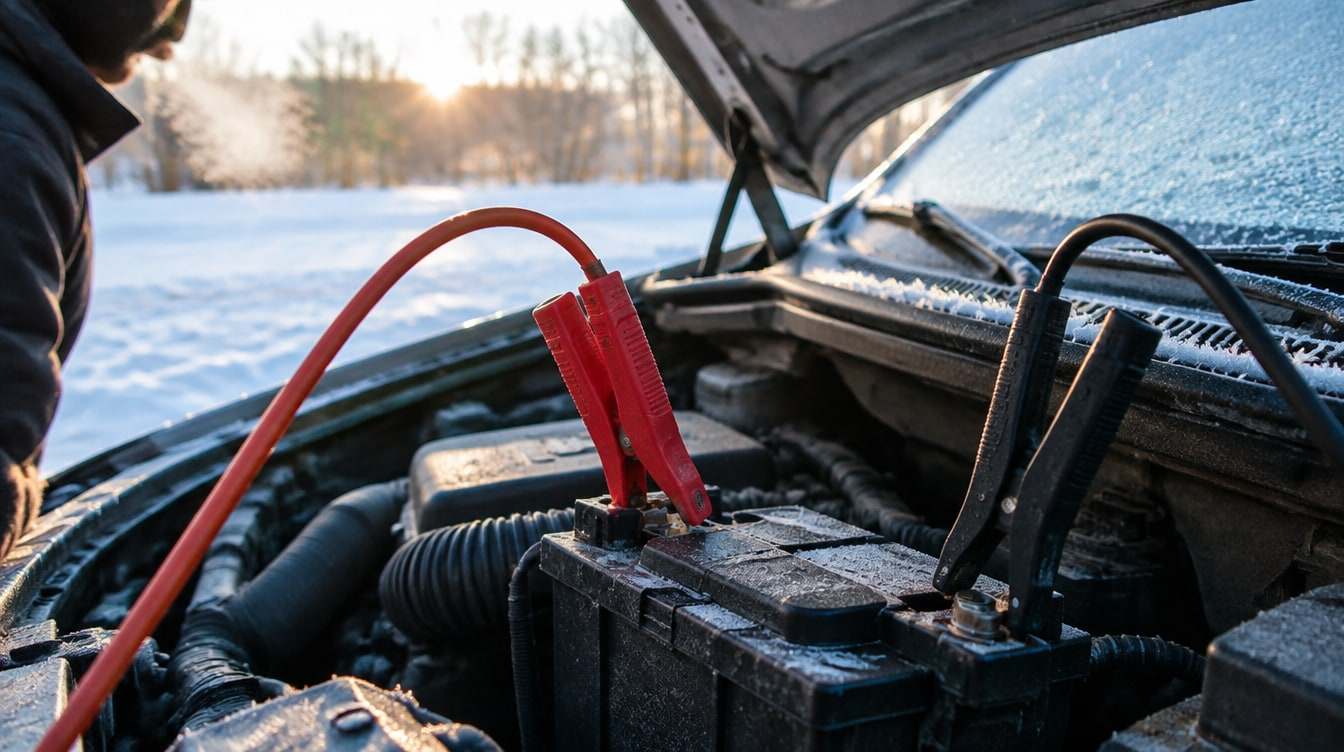
Why Toledo batteries quit in January
At Toledo Express Airport, the official weather station for the city, January’s average low is 20.3°F (NOAA normals), and plenty of nights go lower. Cold works against a battery from both sides: at 0°F a battery loses about 60% of its power while the engine needs about twice the current to start (AAA).
That’s why AAA says battery calls often become the top reason members need roadside help during winter storms, and why it suggests testing any battery more than 3 years old (AAA). AAA names slow cranking as a warning sign. The cold-weather battery guide goes deeper.
Is it really the battery?
A jump only fixes a battery that has run down. Before you call, notice what the car does:
| What you notice | Likely cause | Will a jump help? |
|---|---|---|
| Slow, labored cranking on a cold morning | Weak or discharged battery | Usually |
| Starts on a jump, then dies right away | Alternator not charging | No; it needs a shop |
| Lights dim, or the radio acts up, while the engine runs | Alternator | Only briefly |
| Runs after a jump but won’t restart once shut off | Battery that won’t hold a charge | Enough to reach a shop or parts store |
| Corroded battery terminals | A battery problem | Maybe; have the battery tested |
| Bulging or cracked battery case | Damaged battery | No; don’t jump it |
| Engine cranks at normal speed but won’t catch | Not the battery: fuel, ignition or something else | No |
The alternator signs and the battery signs come from AAA Club Alliance. If the engine turns over normally, the battery is already doing its job; check the fuel gauge, and see fuel delivery if the tank is empty.
Jump-starting safely: the order matters
AAA’s order for jumper cables (AAA Oregon/Idaho, AAA Club Alliance):
- Park the good car close, on level ground, with the two cars not touching. Turn off both engines and all accessories.
- Put on eye protection and gloves.
- Red clamp to the positive (+) terminal of the dead battery.
- Other red clamp to the positive (+) terminal of the good battery.
- Black clamp to the negative (−) terminal of the good battery.
- Last black clamp to unpainted metal or the engine block on the dead car, not to the dead battery. Connecting there can make sparks near the battery and risks an explosion.
- Start the good car, then try the dead one.
- Remove the cables in reverse order, and never let the clamps touch each other.
When a jump won’t help and you need a tow
- The car dies again right after the jump, or won’t restart after a short drive.
- The battery is cracked, leaking or swollen.
- The engine cranks normally but won’t start.
- The lights dim or flicker while the engine runs, which AAA Club Alliance links to the alternator.
- The car is in a spot where cables can’t reach, and no portable booster is available.
For a car that won’t start in a driveway in Sylvania or a narrow street in Ottawa Hills, tell the dispatcher how close a truck can get. If it has to be towed, an emergency tow or a flatbed gets it to a shop.
Hybrids and electric cars
Hybrids and EVs can have different rules from a gas car, so the owner’s manual is the authority on whether and how to jump-start them. Cold matters for them too: NHTSA notes that EV and hybrid range drops in cold weather and recommends keeping an EV plugged in overnight in winter (NHTSA). If an electric car can’t be started and has to be moved, carmakers such as Kia recommend dollies or a flatbed, because turning the drive wheels can damage components (Kia).
What to have ready when you call
- Where the car is: driveway, street, store lot or parking garage level.
- Year, make and model, and whether it is a hybrid or electric.
- What happens when you turn the key or press start: slow crank, clicking, nothing, or normal cranking with no start.
- How old the battery is, if you know.
- Whether the hood can be reached, or the car is nose-in against a wall.
Then call (419) 329-4502 or send a request. If anything else is wrong too, such as keys locked inside, see roadside assistance.